
Laboratory Information Management System
The QC lab’s work in one module, from sample registration to the Certificate of Analysis — every result calculated by the system, checked against its limits as it is entered, and approved by electronic signature.
Download the LIMS product sheet (PDF, 163 KB)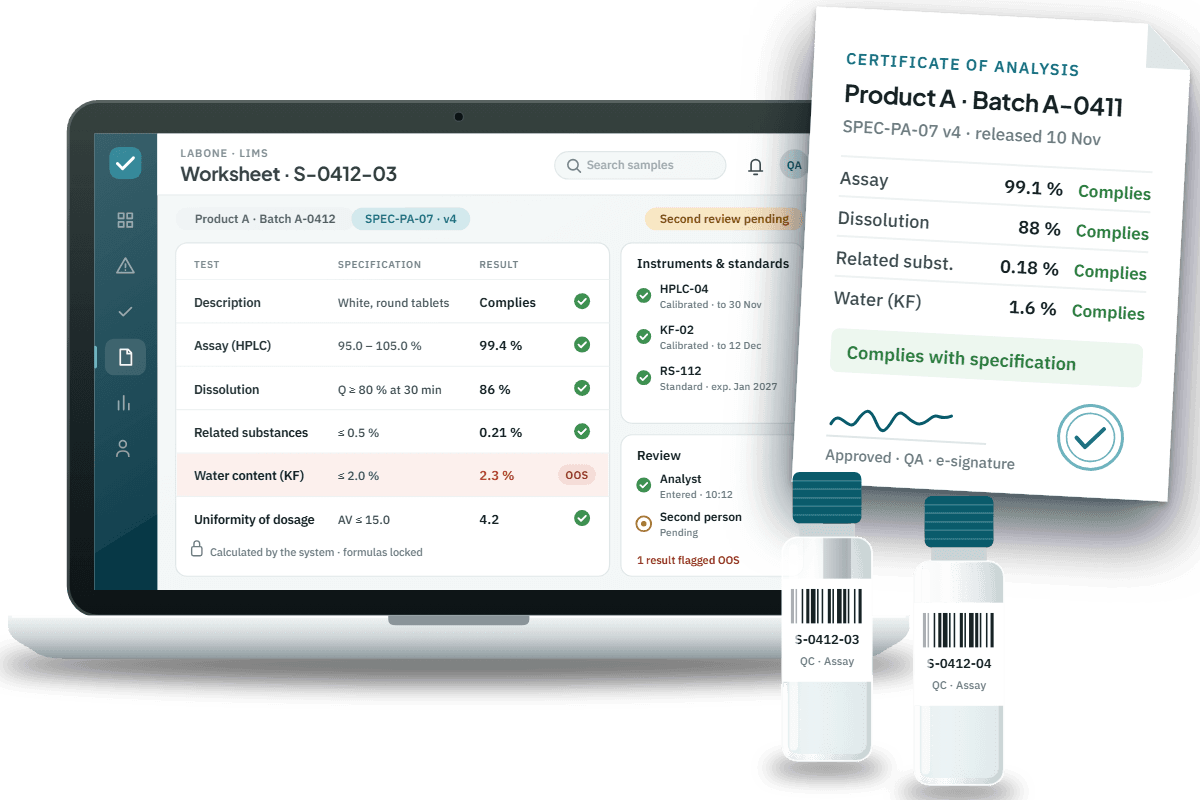
Overview
What is a LIMS, and why move the QC lab off paper?
A laboratory information management system (LIMS) runs the work of a quality control lab: registering samples, assigning the tests their specification calls for, recording and calculating results, and getting them reviewed and approved before a batch is released.
On paper, one result touches a sample register, a notebook, an instrument logbook, a standards register and a printed specification. Transcription errors, unrecorded recalculations and testing against an outdated specification are among the most common data integrity findings in QC labs.
GAMP LIMS keeps that work in one system. Each result is calculated by the system and checked against its approved limit as it is entered, and recorded with the analyst, instrument and standard behind it.
What it covers
- Samples, from receipt to retention
- Specifications and test procedures
- Analysis, results and review
- Certificates of Analysis
- Stability studies
- Instruments, reagents and standards
- Microbiology
Temperature and humidity monitoring of the lab itself is FacilityOne’s job.
Was it tested against the current specification?
In GAMP LIMS:
- Registered: Barcode label and chain of custody
- Tested: Tests from the specification, on electronic worksheets
- Checked: Against approved limits as entered; OOS and OOT flagged
- Reviewed: Second-person review, approved by e-signature
- Released: Certificate of Analysis
Why GAMP
Why teams choose GAMP LIMS
Every sample, tested to the approved version
Samples are registered and labelled at receipt and followed through to retention, and each one is tested against the specification and test procedure currently approved.
GAMP LIMS · in this workflow
- Sample registration, barcode labels and chain of custody, from receipt to retention
- Specifications and standard test procedures under version control
Checked the moment it is entered
Analysts work in electronic worksheets where the system does the arithmetic. Each result is compared with its limit at entry, so an OOS or OOT result is flagged before anyone moves on.
GAMP LIMS · in this workflow
- Electronic worksheets, with calculations done by the system and formulas locked
- Results checked against specification limits as they are entered, with OOS and OOT flagged
Reviewed with the full context
A second person approves the results by electronic signature, with the instrument, reagent and standard behind each test already on the record. The Certificate of Analysis is generated from the approved results.
GAMP LIMS · in this workflow
- Second-person review, approval by electronic signature and the Certificate of Analysis
- Instruments, reagents and standards checked for calibration and expiry, and recorded against each test
The work that runs for days, or years
Stability studies run for years and microbiology plates wait days in the incubator. Both are scheduled in the system, with an alert before a pull or a read-out falls due.
GAMP LIMS · in this workflow
- Stability protocols with pull schedules and due-date alerts
- Microbiology media, incubations and plate counts, with read-out reminders
Where it sits
Part of the GAMP suite
LabOne runs on the same single sign-on and administration layer as every other GAMP platform, so its users, roles and password policy are managed with the rest of the suite.
GAMP suite · 4 platforms
You are here
System AdministratorCORE
The layer every platform runs on — managed once for the whole suite.
- 21 CFR Part 11
- EU Annex 11
- EU Annex 1
- GAMP 5
- ALCOA++
- WHO GDP
- GMP
- ISO/IEC 17025
Benefits
What GAMP LIMS gives you
Across LabOne
Inspection-ready by default
Audit trails, electronic signatures and role-based access are built into LabOne, as they are into every GAMP module.
Joined to the quality system
An out-of-specification result can be raised for investigation in QMS, on ComplianceOne.
Calculations you can trust
Results are calculated by the system on electronic worksheets with locked formulas, so no figure depends on a hand calculation.
Released on a signature
Second-person review and approval by electronic signature lead straight to the Certificate of Analysis.
Stability on schedule
Pull schedules come from the stability protocol, with alerts before each time point falls due.
Every sample accounted for
Barcode labels and chain of custody follow each sample from receipt to retention.
Tested to the current specification
Specifications and test procedures are under version control, so a result is entered against the approved version.
Instruments and standards in status
Nothing out of calibration or past its expiry is used for a test, and what was used stays on the result’s record.
FAQs
Questions teams ask before they start
Which samples can be registered?
Raw material, packaging, in-process, finished product and stability samples, each labelled with a barcode and tracked through testing to retention.
Can specifications follow the pharmacopoeia?
Yes. Each test can carry its pharmacopoeial reference (IP, BP, USP or Ph. Eur.) alongside your own in-house limits. A revised specification goes through review and approval with electronic signatures, and every superseded version is kept.
Can an analyst change a calculation?
No. Formulas are locked in the worksheet template and the system performs the calculation. Every entry and change is kept in the audit trail.
How are OOS results handled?
A result outside its limit is flagged as it is entered. The OOS can then be raised for investigation in ComplianceOne’s QMS, which runs phased OOS investigations.
Is the Certificate of Analysis generated by the system?
Yes. Once a second person has reviewed and approved the results, the CoA is generated from them, so nothing is re-typed onto the certificate.
What happens when an instrument’s calibration is overdue?
The instrument cannot be used until it is calibrated again, so an out-of-status instrument cannot produce a reportable result. Reagents and standards are tracked to expiry in the same way.
Does it cover stability studies and the microbiology lab?
Yes. A stability protocol defines its storage conditions, such as the ICH long-term, intermediate and accelerated ones, and the pull schedule is generated from it. In microbiology, media, incubations and plate counts are tracked, with a reminder when plates are due to be read.
Is it compliant with 21 CFR Part 11 and EU Annex 11?
It provides the technical controls both regulations require: unique logins, a secure computer-generated audit trail on every action, e-signatures that record who signed, when and what the signature means, and role-based access on every record. Compliance also depends on how the system is validated and used at your site.
Which regulations and standards is it built against?
EU Annex 11 and 21 CFR Part 11 for electronic records and signatures; GMP, including EU GMP Annex 1 for sterile manufacture; WHO GDP for storage and distribution; GAMP 5 for the validation approach; ALCOA++ for data integrity; and ISO/IEC 17025 for calibration.
Where can it be deployed?
In the cloud, on-premises or as a hybrid. In the cloud, GAMP hosts, patches and monitors it. On-premises, it runs inside your own data centre. A hybrid splits application and data to match your residency policy.
Who manages users and access?
Your IT team does, through System Administrator: users, plants, departments and designations, module access per user, the role a user holds in each module, and password policy, all set once for the whole suite.
Can we see it against our own process?
Yes. Bring the workflow you run today and we will walk the modules through it, rather than through a scripted demo, and be straight about what would need to change on both sides.
Does it extend to modules added later?
Yes. The administration layer extends automatically to every module added to the suite.