
Line Clearance System
Line clearance completed and verified in the system, with colour e-paper tags on rooms and equipment showing their current status in place of handwritten labels.
Download the LCS product sheet (PDF, 185 KB)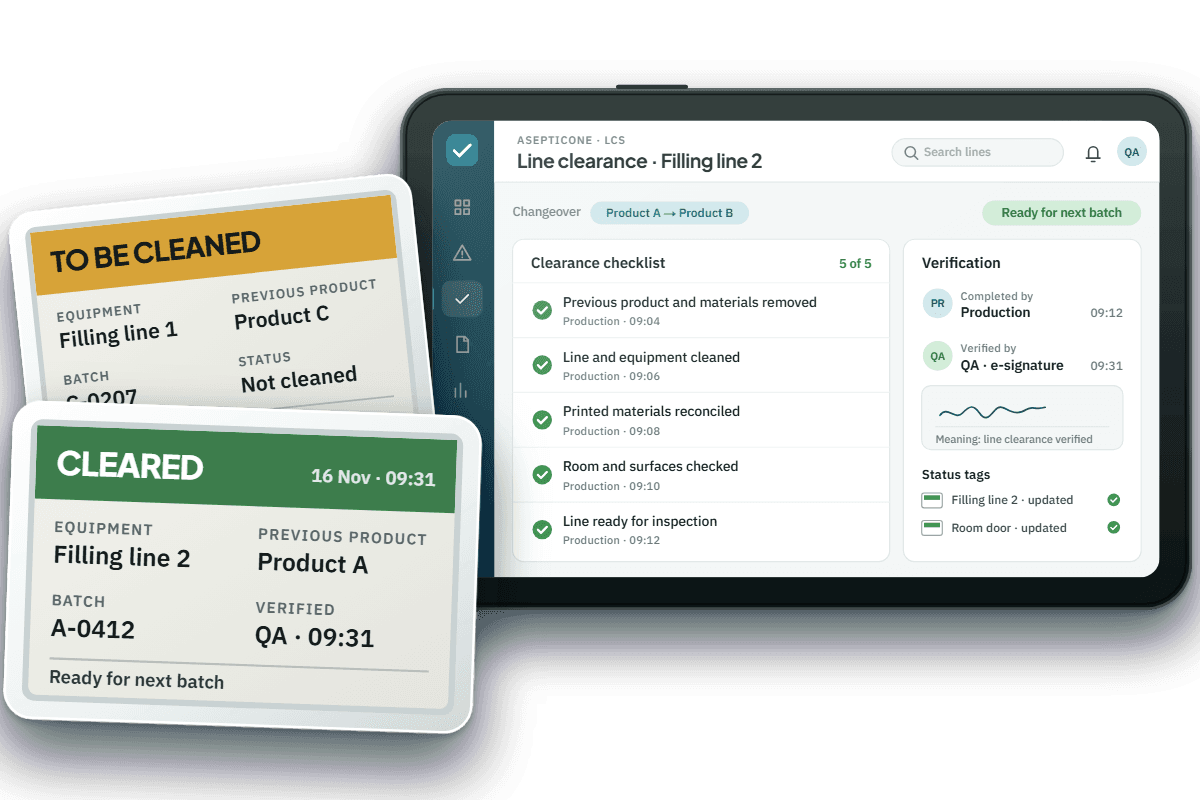
Overview
What is line clearance?
Line clearance is the check that a line, room or piece of equipment holds nothing from the previous batch — no product, components, labels or documents — before the next batch starts. It is one of the main controls against mix-ups and cross-contamination.
On paper, the clearance is a checklist signed at the line, and the status of each room and machine is a handwritten label hung on it. Labels go missing, are not updated, or still say “cleaned” after the equipment has been used again.
LCS runs the checklist and its QA verification in the system, and shows each room’s and machine’s status on a colour e-paper tag that the system updates itself.
Was this line really cleared — and is the label on it still true?
In GAMP LCS:
- Batch complete: The line is ready for changeover
- Cleared: Checklist completed by production
- Verified: Checked by QA, signed electronically
- Tagged: E-paper tags updated by the system
- Released: The line is ready for the next batch
Every changeover runs the same clearance
Why GAMP
Why teams choose GAMP LCS
Cleared, then verified
Each changeover runs its own line clearance checklist, completed by production and verified by QA with an electronic signature.
GAMP LCS · in this workflow
- Line clearance checklists for each line, room and changeover
- Completed by production, verified by QA with e-signature
Status where people look
Colour e-paper tags on rooms and equipment show their current status, and change the moment it changes in the system — no handwritten label to update.
GAMP LCS · in this workflow
- Colour e-paper status tags on rooms and equipment
- Tags updated from the system the moment a status changes
Every clearance on record
Each tag shows the previous product, batch and cleaning status, and every clearance stays on record for the line and the batch.
GAMP LCS · in this workflow
- Previous product, batch and cleaning status shown on each tag
- A complete clearance history for every line and batch
The complete system
Status on the door, set by the system
LCS drives colour e-paper tags and displays from GAMP. When a line clearance is completed and verified, the tags on rooms and equipment change to match — no handwritten labels.
1In your facility
GAMP hardware
2GAMP software
The module and its base
3What you get
From the record
Hardware · GAMP
Colour e-paper tags
Hung on rooms and equipment, each showing its current status.
How it connects
LCS works with GAMP tags and displays only.
Hardware is supplied by GAMP Services Limited, our parent company. Buy the software on its own or as the complete system through us; hardware on its own through GAMP Services Limited.
Where it sits
One module of AsepticOne
AsepticOne’s modules share single sign-on and one administration layer, and entry, intervention and clearance records can be linked across them.
AsepticOne · 3 modules
You are here
System AdministratorCORE
The layer under every AsepticOne module, and under the rest of the suite too.
- 21 CFR Part 11
- EU Annex 11
- EU Annex 1
- GAMP 5
- ALCOA++
- WHO GDP
- GMP
- ISO/IEC 17025
Benefits
What GAMP LCS gives you
Across AsepticOne
One record of the sterile core
Entry, interventions and line clearance are recorded on one platform, so an investigation starts from recorded facts rather than recollection.
Administered once
Operators, supervisors and QA reviewers are set up once for AICS, ACAS and LCS, and removed once when they leave.
Every changeover cleared the same way
The same checklist runs whoever is on shift, so a clearance never depends on someone remembering the steps.
Labels that stay true
E-paper tags change when the status changes in the system, so a room or machine never shows yesterday’s status.
The facts at the equipment
People at the line read the last product, batch and cleaning status off the tag: the same facts the system holds.
QA’s signature, not a tick on paper
Each clearance is verified by QA with an electronic signature before the line is released.
A history for every line
Past clearances can be pulled up by line or by batch whenever a reviewer or an inspector asks.
A control against mix-ups
Every changeover checks for the previous batch’s product, components, labels and documents before the next one starts.
FAQs
Questions teams ask before they start
Is it compliant with 21 CFR Part 11 and EU Annex 11?
It provides the technical controls both regulations require: unique logins, a secure computer-generated audit trail on every action, e-signatures that record who signed, when and what the signature means, and role-based access on every record. Compliance also depends on how the system is validated and used at your site.
Which regulations and standards is it built against?
EU Annex 11 and 21 CFR Part 11 for electronic records and signatures; GMP, including EU GMP Annex 1 for sterile manufacture; WHO GDP for storage and distribution; GAMP 5 for the validation approach; ALCOA++ for data integrity; and ISO/IEC 17025 for calibration.
Where can it be deployed?
In the cloud, on-premises or as a hybrid. In the cloud, GAMP hosts, patches and monitors it. On-premises, it runs inside your own data centre. A hybrid splits application and data to match your residency policy.
Who manages users and access?
Your IT team does, through System Administrator: users, plants, departments and designations, module access per user, the role a user holds in each module, and password policy, all set once for the whole suite.
Can we see it against our own process?
Yes. Bring the workflow you run today and we will walk the modules through it, rather than through a scripted demo, and be straight about what would need to change on both sides.
Does it extend to modules added later?
Yes. The administration layer extends automatically to every module added to the suite.