
Facility Mapping System
Turns the datalogger into a validation instrument for cold room qualification, temperature mapping, and thermal validation.
Download the FMP product sheet (PDF, 184 KB)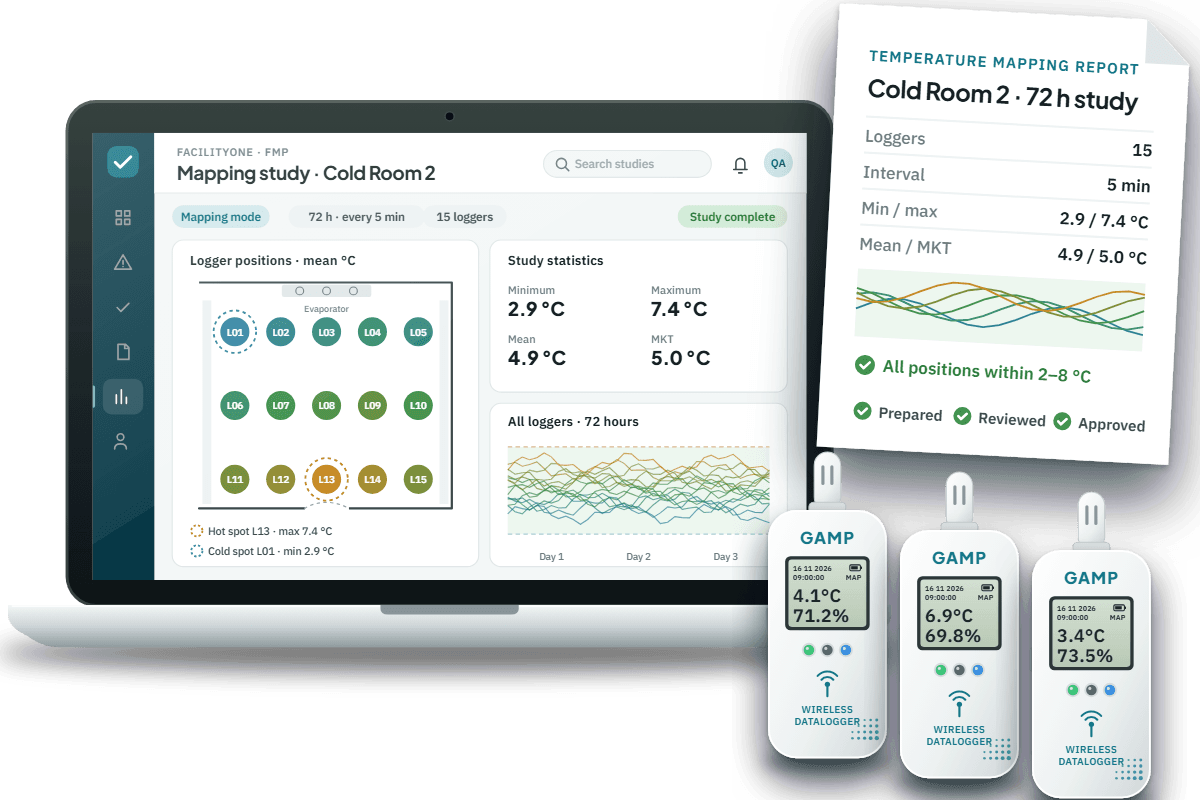
Overview
What is temperature mapping?
No room holds the same temperature everywhere. Air near the door warms each time it opens; the top shelf near a light runs warmer than the floor by the cooling coil. Temperature mapping measures a space at many points at once, so you know where the hot and cold spots are and whether the whole space stays within limits.
Guidance on storage and distribution, including WHO’s, expects storage areas to be mapped before use, after significant changes and at regular intervals, and the results decide where routine monitoring sensors go. FMP makes each study repeatable, documented and easy to review.
What you can map
- Cold rooms
- Warehouses and dispatch bays, including summer and winter studies
- Temperature-controlled chambers
- Vehicles used in the cold chain
Could the study be repeated the same way next year?
In GAMP FMP:
- Planned: Loggers placed through the space
- Mapping: Scheduled start and stop, logging every 1–60 minutes
- Analysed: Hot and cold spots, with statistics
- Reported: An audit-ready study report
- Monitored: The loggers move into routine monitoring
Remapped after significant changes and at regular intervals
Why GAMP
Why teams choose GAMP FMP
Turn a datalogger into a validation instrument
Logging intervals under your control from one to sixty minutes, and a mapping mode with scheduled start and stop for a study that runs itself.
GAMP FMP · in this workflow
- User-controlled logging intervals, 1 to 60 minutes
- Mapping mode with start/stop scheduling
Studies that stand up to review
Audit-ready reports with graphs and statistics, and deviation and statistical summaries presented the way a reviewer expects to see them.
GAMP FMP · in this workflow
- Audit-ready study reports with graphs and statistics
- Deviation and statistical summaries
Calibrated without losing the room
Interchangeable sensors are swapped, so the space is never taken out of service for calibration, and accredited calibration is there when you need it.
GAMP FMP · in this workflow
- Calibration without downtime via interchangeable sensors
- Calibration by ISO/IEC 17025-accredited laboratories, traceable to national standards
The complete system
The same loggers, now a mapping study
FMP works with GAMP wireless dataloggers. They are placed through the space for the study, and the software turns their readings into the mapping report.
1In your facility
GAMP hardware
2GAMP software
The module and its base
3What you get
From the record
Hardware · GAMP
Wireless dataloggers
Placed through the cold room, chamber, warehouse or vehicle being mapped.
How it connects
FMP works with GAMP wireless dataloggers only.
Hardware is supplied by GAMP Services Limited, our parent company. Buy the software on its own or as the complete system through us; hardware on its own through GAMP Services Limited.
Where it sits
One module of FacilityOne
FacilityOne’s modules share single sign-on and one administration layer, and readings, studies and samples can be linked across them.
FacilityOne · 3 modules
You are here
System AdministratorCORE
The layer under every FacilityOne module, and under the rest of the suite too.
- 21 CFR Part 11
- EU Annex 11
- EU Annex 1
- GAMP 5
- ALCOA++
- WHO GDP
- GMP
- ISO/IEC 17025
Benefits
What GAMP FMP gives you
Across FacilityOne
Every controlled space in one place
Monitoring, mapping and microbial air sampling run on one platform with one administration layer, so every room, chamber and cleanroom is managed in the same place.
Continuous, not periodic
Conditions are proven around the clock rather than at whatever moment somebody happened to take a reading.
Studies that run to protocol
A scheduled start and stop, at the logging interval you choose, means a study runs as written without someone standing in the room.
No report to assemble
The study report comes out of the system complete, so nobody rebuilds it from exported readings.
Approved by e-signature
Each study report is approved with an electronic signature, and every reading behind it keeps its audit trail.
Hot and cold spots found
Statistical summaries show where a space runs warm or cold, so routine monitoring points go where they matter.
Repeatable next time
The interval, schedule and duration of a study are on record, so the next study of the same space can be run the same way.
From study to monitoring
When the study is done, its loggers can stay on as routine monitoring points in FMS.
FAQs
Questions teams ask before they start
How does the datalogger work as a validation instrument?
Put into mapping mode, the logger records at the interval you set, from 1 to 60 minutes, and starts and stops on schedule, so a qualification study runs to its protocol unattended. The study then produces its report, with graphs and statistics.
How long should a temperature mapping study run?
It depends on the space and the guidance you follow. Equipment is often mapped for at least 24–72 hours, and large warehouses for longer to capture a full weekly cycle. Your protocol sets the duration and FMP runs to it.
How many data loggers does a mapping study need?
It depends on the volume and layout. A typical study places loggers in a three-dimensional grid across top, middle and bottom levels, with extra loggers near doors, cooling coils and other likely hot or cold spots.
How often should a warehouse or cold room be re-mapped?
After any significant change to the space or its equipment, and periodically as your risk assessment sets out. Many sites re-map warehouses in both summer and winter.
Can mapping loggers be used for monitoring afterwards?
Yes. The same hardware can move from a mapping study in FMP to routine monitoring in FMS.
Is it compliant with 21 CFR Part 11 and EU Annex 11?
It provides the technical controls both regulations require: unique logins, a secure computer-generated audit trail on every action, e-signatures that record who signed, when and what the signature means, and role-based access on every record. Compliance also depends on how the system is validated and used at your site.
Which regulations and standards is it built against?
EU Annex 11 and 21 CFR Part 11 for electronic records and signatures; GMP, including EU GMP Annex 1 for sterile manufacture; WHO GDP for storage and distribution; GAMP 5 for the validation approach; ALCOA++ for data integrity; and ISO/IEC 17025 for calibration.
Where can it be deployed?
In the cloud, on-premises or as a hybrid. In the cloud, GAMP hosts, patches and monitors it. On-premises, it runs inside your own data centre. A hybrid splits application and data to match your residency policy.
Who manages users and access?
Your IT team does, through System Administrator: users, plants, departments and designations, module access per user, the role a user holds in each module, and password policy, all set once for the whole suite.
Can we see it against our own process?
Yes. Bring the workflow you run today and we will walk the modules through it, rather than through a scripted demo, and be straight about what would need to change on both sides.
Does it extend to modules added later?
Yes. The administration layer extends automatically to every module added to the suite.