
FacilityOne
Every critical environment, continuously proven.
Environmental monitoring, mapping and microbial air sampling — validation studies, viable air monitoring and 24/7 oversight of cold rooms, cleanrooms, warehouses, and transport.
Overview
What is FacilityOne?
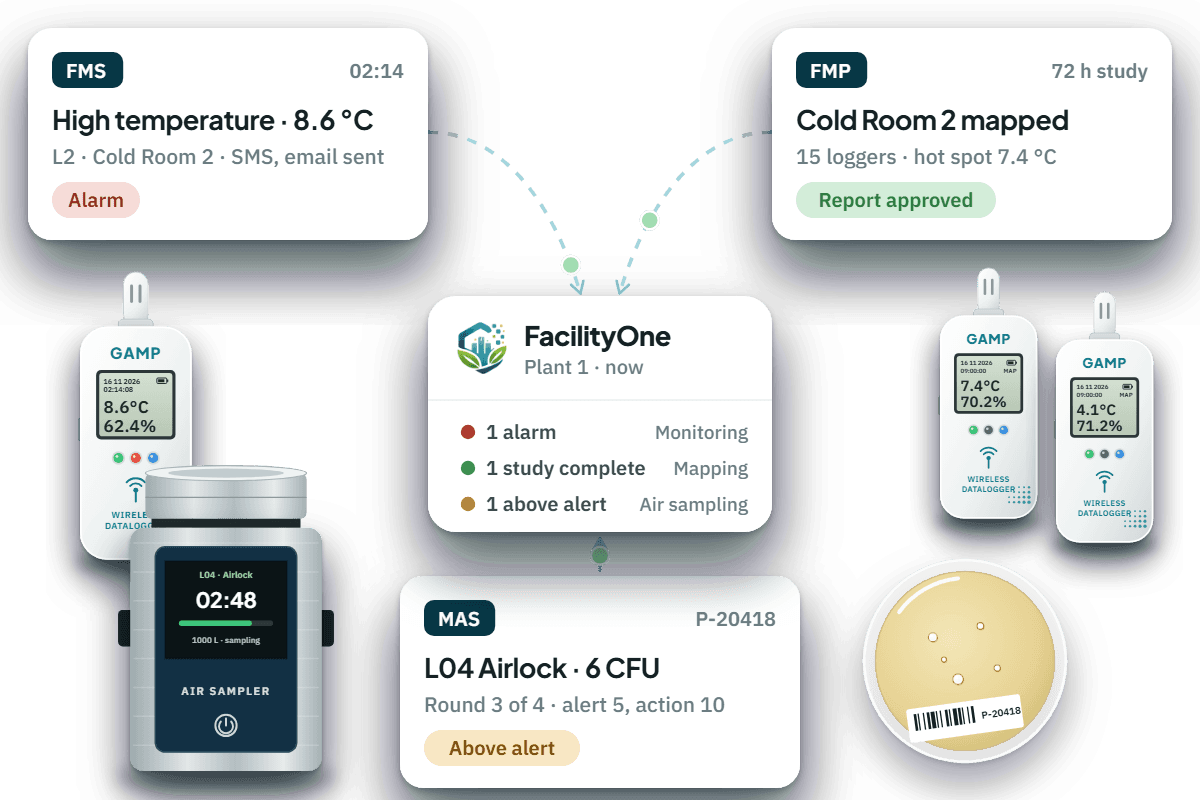
FacilityOne is GAMP Lifetech’s environmental monitoring and mapping platform. It runs the validation studies that qualify a cold room, warehouse or vehicle, the round-the-clock oversight once the space is in use, and the viable air monitoring of cleanrooms with online and portable microbial air samplers.
Wireless dataloggers report encrypted readings as they are taken — MQTT loggers without any gateway, LoRaWAN loggers through one on large sites. The same hardware that monitors a space day to day can be put into mapping mode to qualify it.
Built for: Warehouse, validation, engineering, microbiology and QA teams responsible for controlled environments.
Module stack
3 modulesWhy it exists
What this replaces
A chart on the wall tells you what the room was doing when somebody last looked at it. That is not the same as knowing.
Run on paper
Run on FacilityOne
What’s inside
The modules, and what each one does
Facility Monitoring System
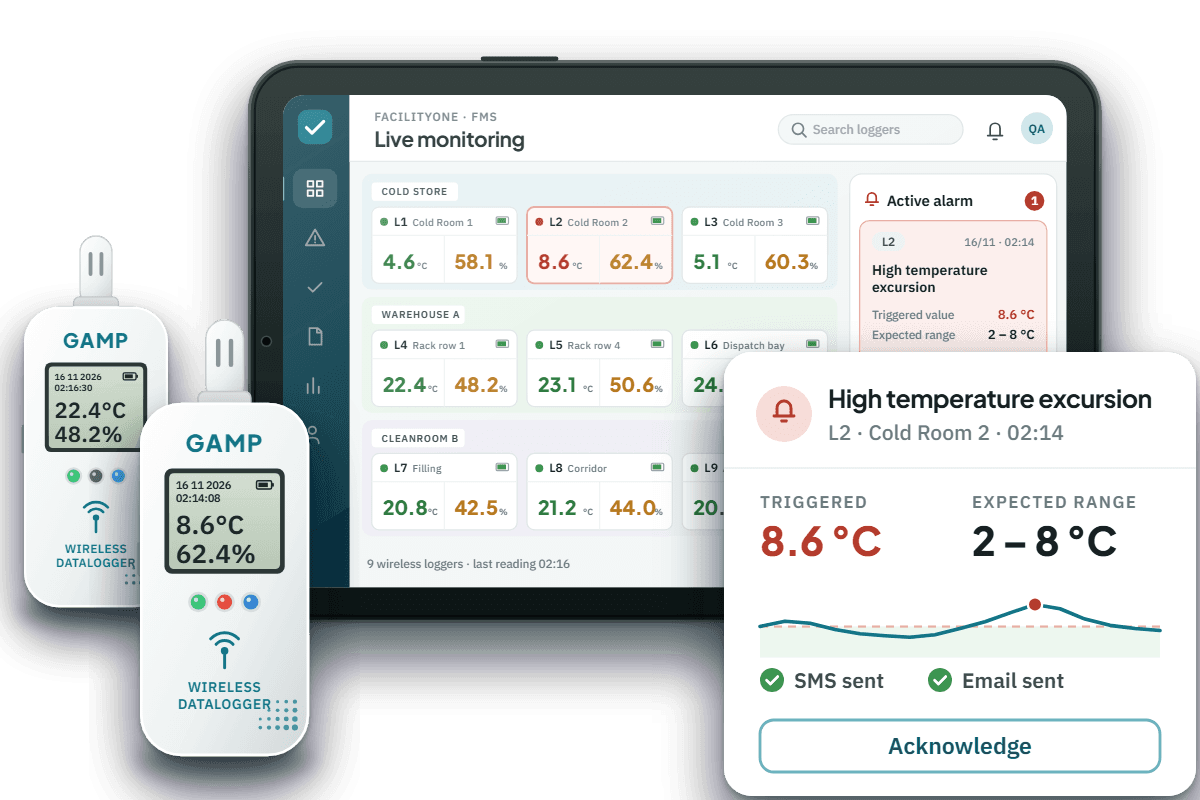
Continuous monitoring with wireless dataloggers transmitting encrypted data in real time: MQTT loggers with no gateway, or LoRaWAN loggers for large sites.
CapabilitiesFMS · Capabilities
- Real-time dashboard with live sensor analytics
- Instant threshold alarms by SMS and email
- MKT (mean kinetic temperature) reporting
- Offline storage protects readings if the network drops
- Multi-brand sensor support via REST API
- Automated trend, deviation, and compliance reports
Facility Mapping System
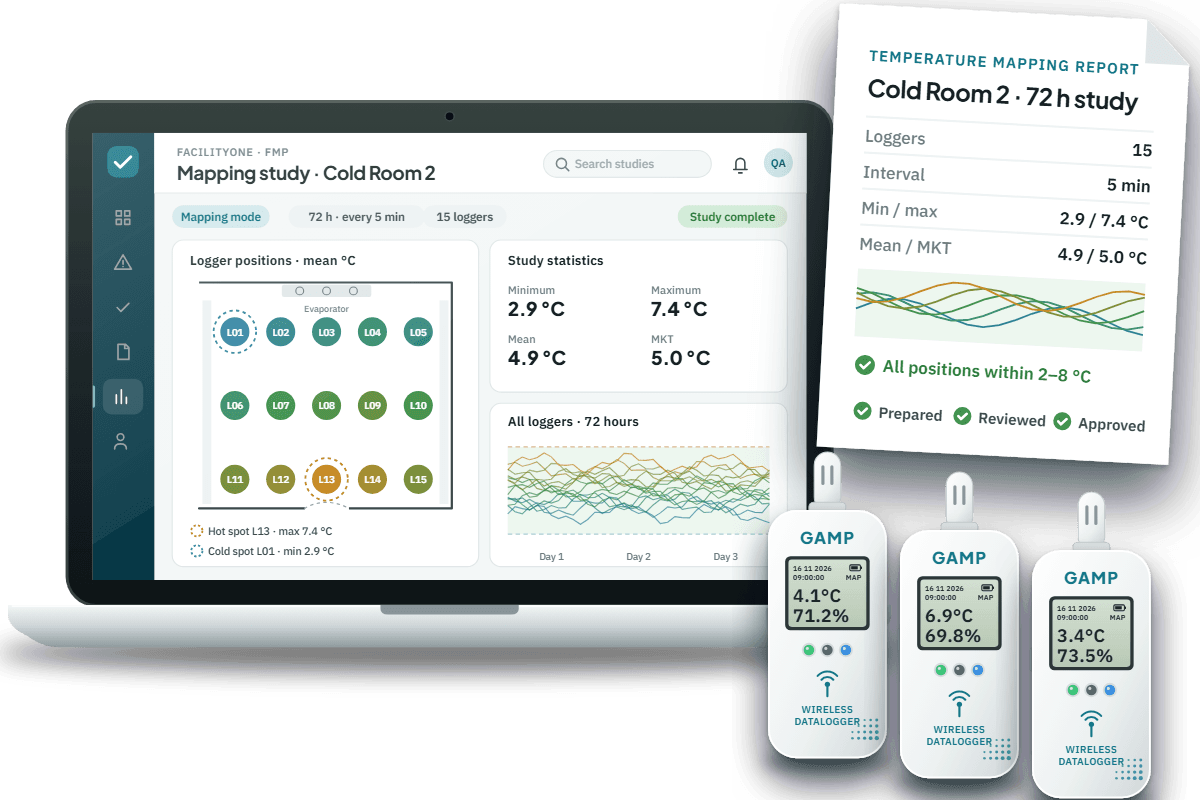
Turns the datalogger into a validation instrument for cold room qualification, temperature mapping, and thermal validation.
CapabilitiesFMP · Capabilities
- User-controlled logging intervals, 1 to 60 minutes
- Mapping mode with start/stop scheduling
- Audit-ready study reports with graphs and statistics
- Deviation and statistical summaries
- Calibration without downtime via interchangeable sensors
- Calibration by ISO/IEC 17025-accredited laboratories, traceable to national standards
Microbial Air Sampling System
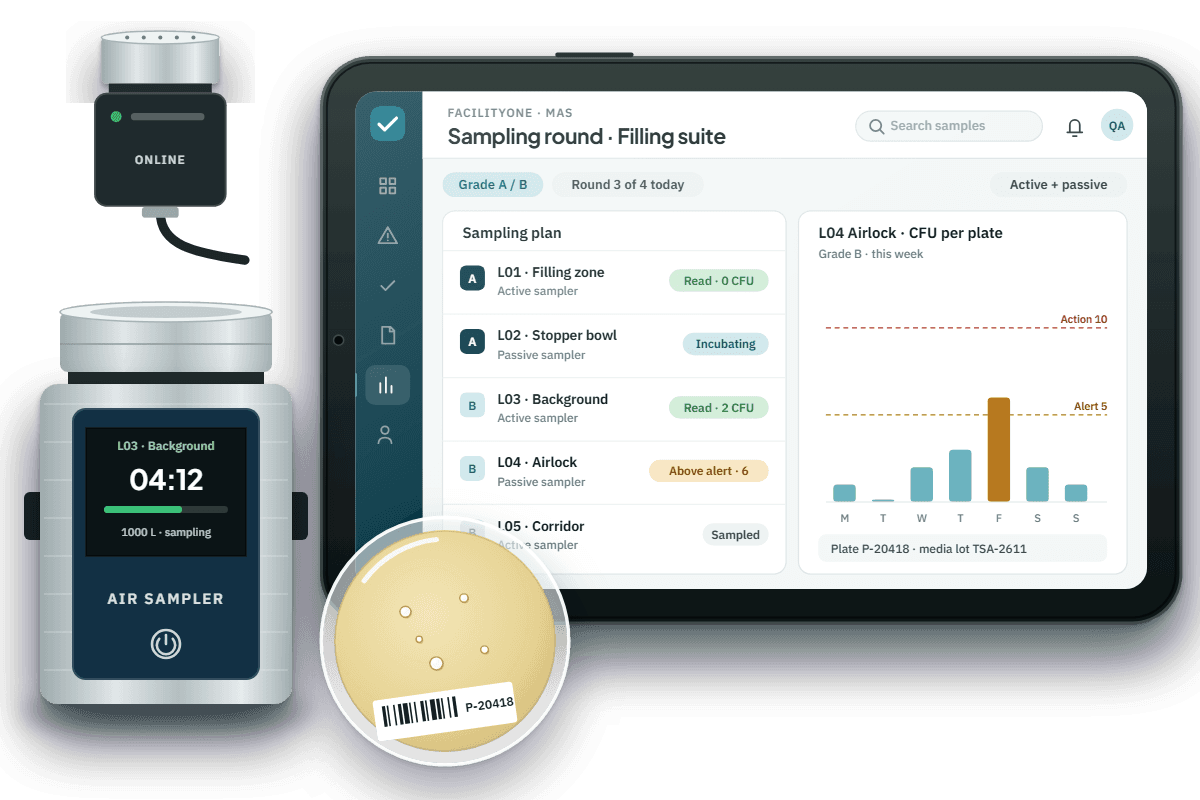
Viable air monitoring from online and portable microbial air samplers in one system — every sample tied to its location, plate and colony count, and checked against its limits.
CapabilitiesMAS · Capabilities
- Online samplers for continuous viable monitoring in critical zones
- Portable samplers for scheduled sampling rounds
- Sampling plans by room, grade and location
- Plate tracking from media lot through incubation
- Colony counts checked against alert and action limits
- Trend reports by location, room and grade
Shared across the suite
System Administrator
One set of users for FMS, FMP and MAS
Engineers, QA reviewers and warehouse teams are created once and given the FacilityOne modules their work needs, for the sites they cover.
- FMS, FMP and MAS access granted per user, site by site
- Each person given the role their work calls for in each module
- One password policy for every FacilityOne login
- Every change to a user’s access kept in the activity log
Standards
Built against the frameworks you are held to
- 21 CFR Part 11
- EU Annex 11
- EU Annex 1
- GAMP 5
- ALCOA++
- WHO GDP
- GMP
- ISO/IEC 17025
Deployment
Monitoring data, where your policy requires it
Cloud
Hosted, patched and monitored by GAMP. Nothing for your IT team to run.
On-premises
Inside your own data centre, so readings and study reports never leave infrastructure you control.
Hybrid
Application and data split to match your residency policy.
Benefits
What FacilityOne gives you
Continuous, not periodic
Conditions are proven around the clock rather than at whatever moment somebody happened to take a reading.
No gateway on MQTT loggers
MQTT dataloggers transmit encrypted data directly, with no gateway to install, qualify or maintain. LoRaWAN loggers, for large sites, send through a gateway.
Validation and monitoring in one place
The qualification study and the live oversight that follows it run on the same system and the same data.
Readings survive the network
Onboard storage holds data if the connection drops, so a network fault never becomes a gap in the record.
FAQs
Questions teams ask before they start
Why does it matter that the MQTT loggers need no gateway?
A gateway is one more device to install, qualify, power and maintain, and if it fails every sensor behind it goes quiet. FacilityOne’s MQTT dataloggers send data directly, which removes that single point of failure. For large sites, LoRaWAN loggers trade that for long range and send through a gateway.
Can the same loggers do temperature mapping and monitoring?
Yes. A logger can run a mapping study in FMP and then move into routine monitoring in FMS, so the study that justifies each monitoring point was made with the same hardware that now watches it.
Can we use sensors we already own?
Often, yes. FMS accepts data from sensors of more than one make through a REST API. Tell us what you have and we will confirm.
How is sensor calibration handled?
Sensors are interchangeable: a calibrated sensor is swapped in while the other goes for calibration, so the space is never left unmonitored. Where your quality system requires it, the calibration is done by an ISO/IEC 17025-accredited laboratory.
Is it compliant with 21 CFR Part 11 and EU Annex 11?
It provides the technical controls both regulations require: unique logins, a secure computer-generated audit trail on every action, e-signatures that record who signed, when and what the signature means, and role-based access on every record. Compliance also depends on how the system is validated and used at your site.
Which regulations and standards is it built against?
EU Annex 11 and 21 CFR Part 11 for electronic records and signatures; GMP, including EU GMP Annex 1 for sterile manufacture; WHO GDP for storage and distribution; GAMP 5 for the validation approach; ALCOA++ for data integrity; and ISO/IEC 17025 for calibration.
Where can it be deployed?
In the cloud, on-premises or as a hybrid. In the cloud, GAMP hosts, patches and monitors it. On-premises, it runs inside your own data centre. A hybrid splits application and data to match your residency policy.
Who manages users and access?
Your IT team does, through System Administrator: users, plants, departments and designations, module access per user, the role a user holds in each module, and password policy, all set once for the whole suite.
Can we see it against our own process?
Yes. Bring the workflow you run today and we will walk the modules through it, rather than through a scripted demo, and be straight about what would need to change on both sides.
Does it extend to modules added later?
Yes. The administration layer extends automatically to every module added to the suite.