
EU GMP Annex 1, explainedSterile manufacturing under the 2022 Annex 1
Annex 1 sets the rules for making sterile medicines in the EU and PIC/S world. The 2022 revision turned it from a list of limits into a strategy: understand every contamination risk, control it, and prove the controls work. This guide covers who may enter Grade A and B, how interventions must be handled and what a media fill must show, with the paragraph numbers to check.
- Issued by
- European Commission, EU GMP Guide (EudraLex Volume 4), revised jointly with PIC/S and WHO
- Applies to
- Manufacture of sterile medicinal products; its principles can also support other products where contamination control matters
- In force
- Published 25 August 2022; in operation since 25 August 2023, and point 8.123 (lyophilisers) since 25 August 2024
In plain words
What EU GMP Annex 1 is about
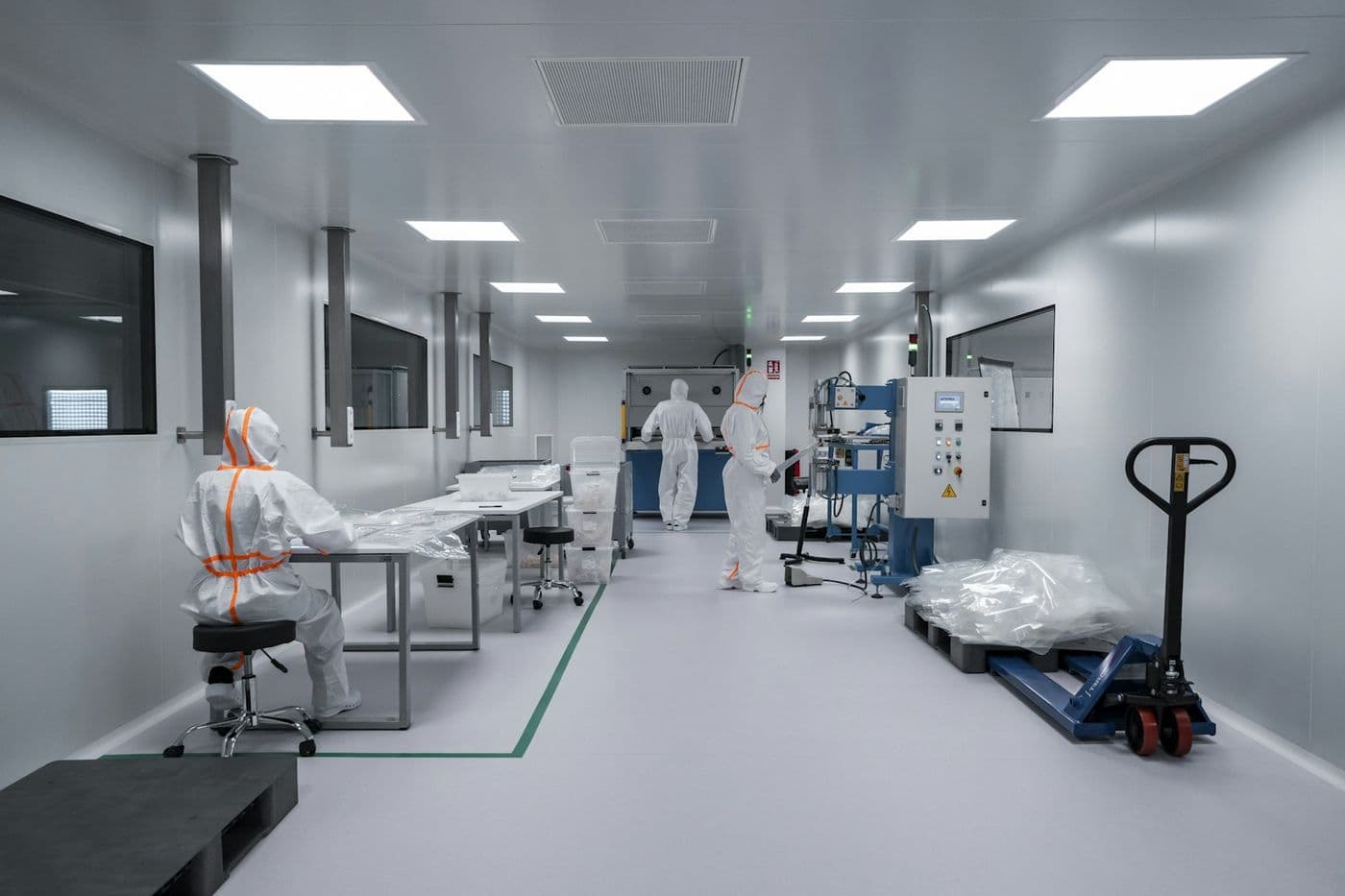
Annex 1 covers the manufacture of sterile products: aseptic processing, terminal sterilisation, the Grade A to D cleanrooms, utilities, personnel and the monitoring around them.
At its centre is the Contamination Control Strategy, or CCS (2.3). This is a facility-wide strategy that defines every critical control point, and it assesses how well the design, procedural, technical and organisational controls and the monitoring work together. Existing systems can stay, but they must be referenced in the CCS. The strategy is reviewed, updated and part of management review.
People are the largest source of contamination in a cleanroom, so the Annex is specific about who may enter, how they qualify, and how every intervention they make is designed, approved, recorded and simulated in media fills.
What it asks for
The requirements, clause by clause
- 2.3–2.6
Contamination control strategy
A facility-wide CCS defines critical control points and assesses all controls and monitoring. It considers at least sixteen elements (2.5), from plant design, personnel and vendor approval to cleaning, monitoring, CAPA and continuous improvement, and it is kept under periodic review.
- 7.2
Minimum people
Only the minimum number of people should be in cleanrooms. The maximum number of operators is determined, documented and considered during qualification and media fills.
- 7.4
Gowning qualification
People entering Grade A and B are trained in aseptic gowning and behaviour. Compliance is assessed visually and microbiologically and reassessed at least annually. Unsupervised access is restricted to people who passed the gowning assessment and took part in a successful media fill.
- 7.5–7.6
Unqualified people and disqualification
Unqualified people do not enter Grade B, or Grade A in operation, except under written, supervised exception that is assessed and recorded. Systems must disqualify people after adverse monitoring trends or a failed media fill, with retraining and requalification before they return.
- 8.16
Authorised interventions
An authorised list of allowed and qualified interventions, inherent and corrective, each designed to minimise risk and evaluated through risk management and media fills. Non-qualified interventions only in exceptional cases with quality-unit authorisation, then risk-assessed, recorded, investigated and considered at batch disposition.
- 8.17
Recording interventions
Interventions and stoppages are recorded in the batch record with the time, duration and the operators involved.
- 9.16–9.17
Grade A particle monitoring
Continuous monitoring of particles of 0.5 and 5 µm and above for the full duration of critical processing, including equipment assembly, at no less than 28 litres a minute, with alarms when alert levels are exceeded.
- 9.24
Grade A viable monitoring
Continuous viable air monitoring in Grade A (air sampling or settle plates) for the full duration of critical processing; a similar approach is considered for Grade B according to risk.
- 9.26
Personnel monitoring
Microbial monitoring of personnel in Grade A and B, at locations and frequencies set by risk assessment.
- 9.34–9.35
Interventions in the media fill
Media fills include the inherent and corrective interventions of routine production, at a similar frequency, chosen by risk. A media fill may not be used to justify practices that pose unnecessary contamination risk.
- 9.38
How often media fills run
Initial validation needs at least three consecutive successful runs covering all shifts. Revalidation is normally twice a year for each aseptic process, filling line and shift, and each operator takes part in at least one successful media fill a year.
- 9.46–9.47
Media fill results and records
The target is zero growth; any contaminated unit fails the media fill. Every run is fully documented, including each intervention with its start and end time and the person involved.
Where inspections find gaps
Where sites usually slip
- A CCS that sits beside the operationControls are listed, but their combined effectiveness is never assessed, and the strategy is not what the site actually runs on.
- Intervention logs written laterPaper logs filled in after the event, missing the time, the duration or the operator that 8.17 asks for.
- Production outpacing the media fillCorrective interventions happen more often in routine production than the media fills ever simulated (9.34).
- Qualification lapsed at the doorOperators working unsupervised in Grade A or B with an expired gowning assessment or no successful media fill on record (7.4).
- Monitoring that misses interventionsGrade A sampling that is not continuous for the full duration, so interventions and transient events go uncaptured (9.17, 9.24).
- Unauthorised interventionsNon-qualified interventions performed without quality-unit authorisation or review at batch disposition (8.16).
What to ask of software
Questions for any vendor
At a glance
Inherent, corrective and critical interventions
The 2022 Annex defines three kinds of intervention in its Glossary. Every intervention on the authorised list (8.16) is inherent or corrective, and either kind can also be critical.
| Type | What the Annex says it is | Examples given in the Annex |
|---|---|---|
| Inherent | An integral part of the aseptic process, required for set-up, routine operation or monitoring, and required by procedure or work instruction | Aseptic assembly, container replenishment, environmental sampling |
| Corrective | Performed to correct or adjust the process while it runs; may not occur at a set frequency | Clearing component jams, stopping leaks, adjusting sensors, replacing equipment parts |
| Critical | Any intervention, inherent or corrective, into the critical zone | Applies on top of the two types above |
Where GAMP Lifetech helps
The modules behind EU GMP Annex 1 records
- AICSAsepticOneAseptic Intervention Compliance SystemRecords every intervention at the point of action (type, duration, frequency, personnel and location) on a cleanroom interface, with real-time QA review and links to smoke studies, airflow patterns and media fills (8.16, 8.17, 9.34).See the module
- ACASAsepticOneAseptic Controlled Authorization SystemGates sterile-zone entry on qualification and records every entry and exit automatically; the entry records link to the interventions made inside (7.4–7.6).See the module
- MASFacilityOneMicrobial Air Sampling SystemSoftware for online and portable microbial air samplers, for the viable air monitoring programme of section 9.See the module
- TMSComplianceOneTraining Management SystemTraining, assessment and competency records behind each person's qualification (7.3–7.4).See the module
- QMSComplianceOneQuality Management SystemDeviations, investigations and CAPA when monitoring, an intervention or a media fill goes wrong: the prevention mechanisms the CCS lists (2.5 xv).See the module
Every GAMP Lifetech module keeps its own computer-generated audit trail, electronic signatures and role-based access, with single sign-on across the suite through System Administrator.
FAQs
Questions people ask about EU GMP Annex 1
When did the revised Annex 1 come into force?
It was published on 25 August 2022 and came into operation on 25 August 2023. Point 8.123, on lyophilisers and their loading areas, applied from 25 August 2024.
Does Annex 1 apply outside the EU?
It is part of EU GMP and was revised jointly with PIC/S and WHO, and PIC/S inspectorates apply the same text. Sterile manufacturers exporting to Europe or PIC/S markets, including many in India, are inspected against it.
What is the difference between inherent and corrective interventions?
An inherent intervention is part of the process itself, required by procedure for set-up, routine operation or monitoring, such as aseptic assembly or environmental sampling. A corrective intervention fixes or adjusts the process while it runs, such as clearing a jam or replacing a part. Either becomes a critical intervention if it enters the critical zone.
How must interventions be recorded?
Paragraph 8.17 asks for interventions and stoppages to be recorded in the batch record with the associated time, the duration and the operators involved. Interventions must also come from an authorised, qualified list (8.16), and every intervention performed during a media fill is recorded with its start and end time (9.47).
How often must media fills be run under Annex 1?
Initially at least three consecutive successful runs covering all shifts, then normally twice a year (about every six months) for each aseptic process, filling line and shift. Each operator should take part in at least one successful media fill a year (9.38).
Who may enter Grade A and B areas?
Unsupervised access is restricted to people who have passed the gowning assessment, reassessed at least annually, and taken part in a successful media fill (7.4). Unqualified people enter only in exceptional cases, under a written procedure and supervision, with the access assessed and recorded (7.5).
Keep reading
Next, read these
- ALCOA++The ten qualities that make a GxP record trustworthy, on paper and in software.
FDA, MHRA, PIC/S, EMA
GlobalALCOA++
5 requirements5 min read - EU GMP Annex 11How every computerised system used in GMP is validated, secured and kept in control across its life.
European Commission
EUAnnex 11
16 requirements7 min read - Revised Schedule MIndia's GMP rules, rewritten around a pharmaceutical quality system, risk management and data integrity.
MoHFW and CDSCO
IndiaSch. M
10 requirements6 min read
From the library
Official sources
- EU GMP Annex 1: Manufacture of sterile medicinal products (2022)
- EudraLex Volume 4: EU GMP guidelines
- EU GMP Annex 1 in the GxP glossary
This guide explains EU GMP Annex 1 in plain words; it is not legal advice. Check the current official text before acting on it, and remember that compliance depends on how a system is validated and used, not on the software alone. Last updated .