
Aseptic Intervention Compliance System
Automated recording of every intervention — type, duration, frequency, personnel, and location — via a dedicated cleanroom interface.
Download the AICS product sheet (PDF, 194 KB)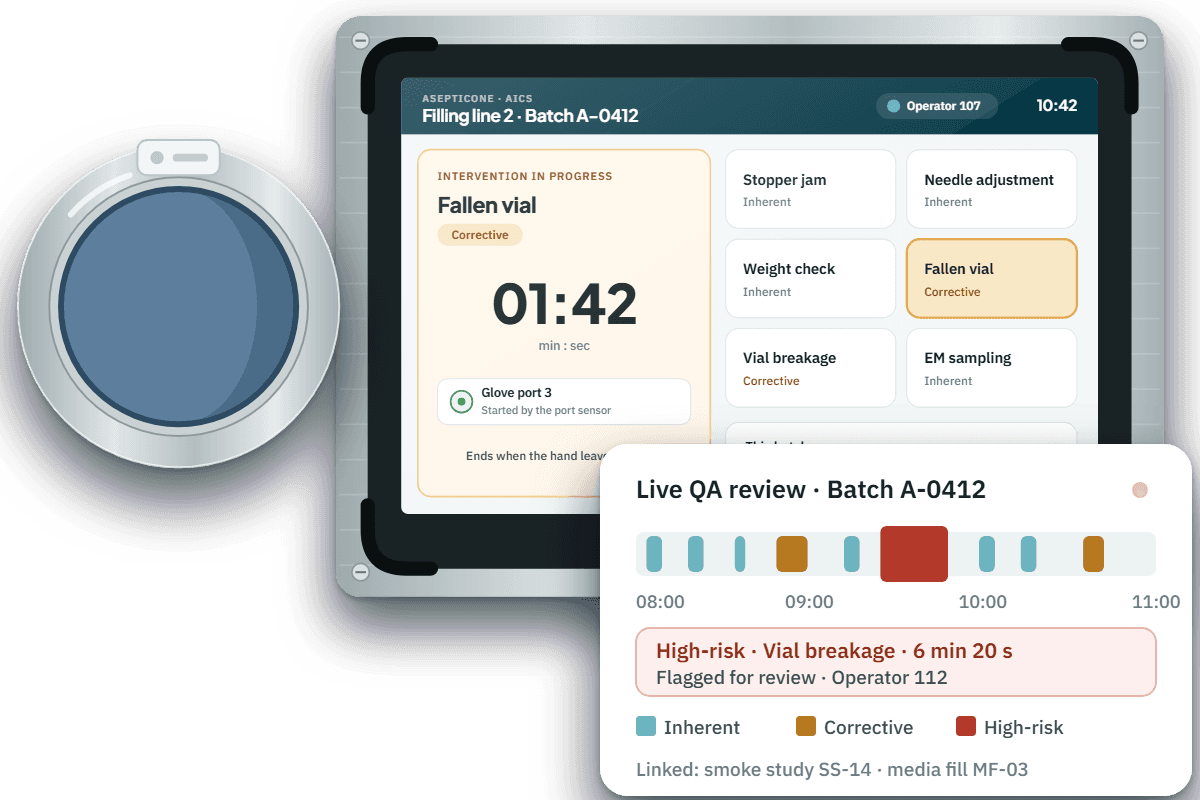
Overview
What counts as an aseptic intervention?
An aseptic intervention is any time a person acts inside or next to the critical zone of a sterile filling line. Some are part of the normal process, such as setting up the line or taking environmental samples; EU GMP Annex 1 calls these inherent interventions. Others correct a problem as it happens: clearing a jammed stopper, replacing a part or removing a fallen vial.
Each one carries a contamination risk. Annex 1 expects manufacturers to keep an approved list of permitted interventions, include them in media fills at realistic frequencies, and record and assess any intervention that happens during production.
On paper, operators complete the intervention log after the event, from memory. AICS records it while it happens.
Two kinds, as Annex 1 defines them
Inherent
Part of the aseptic process itself
- Aseptic set-up and assembly
- Replenishing containers and components
- Environmental monitoring samples
Corrective
Made to correct the process as it runs
- Clearing a component stoppage
- Adjusting a sensor or setting
- Replacing an equipment part
How long did it take, and who was at the line?
In GAMP AICS:
- Intervention: Inherent or corrective, at the line
- Recorded: On the Cleanroom TAB, as it happens
- Reviewed: By QA in real time, while the batch runs
- Flagged: High-risk interventions and abnormal patterns
- Linked: To smoke studies, airflow patterns and media fills
Batch history standardises the next protocol
Why GAMP
Why teams choose GAMP AICS
Recorded where the work happens
Interventions captured automatically on a cleanroom interface, and visible in real time so QA can review while the batch is still running.
GAMP AICS · in this workflow
- Automated intervention recording on Cleanroom TAB
- Real-time visualisation for immediate QA review
Justified against the science
Records are tied to the qualification evidence behind each intervention, and protocols are standardised from what historical batches actually show.
GAMP AICS · in this workflow
- Linked to smoke studies, airflow patterns, and media fills
- Standardised protocols from historical batch data
Investigate with the full picture
High-risk interventions and abnormal patterns flagged as they occur, with complete traceability behind any deviation investigation that follows.
GAMP AICS · in this workflow
- High-risk intervention and abnormal pattern alerts
- Complete traceability for deviation investigations
The complete system
Sensors start the clock, AICS keeps the record
AICS uses door and glove-port sensors from GAMP, and a Cleanroom TAB at the line. When a hand enters a glove port, the intervention’s start and end are captured for its type — no one writes the times down afterwards.
1In your facility
GAMP and compatible vendors
2GAMP software
The module and its base
3What you get
From the record
Hardware · GAMP
Glove-port sensors
Detect a hand entering the port, starting and ending the intervention.
How it connects
AICS works with GAMP sensors or the ones already on your line. Connecting another maker’s hardware is an integration project, carried out with that manufacturer and your team.
Hardware is supplied by GAMP Services Limited, our parent company; the Cleanroom TAB is sourced from compatible vendors and supplied with the system. Buy the software on its own or as the complete system through us; hardware on its own through GAMP Services Limited.
Where it sits
One module of AsepticOne
AsepticOne’s modules share single sign-on and one administration layer, and entry, intervention and clearance records can be linked across them.
AsepticOne · 3 modules
You are here
System AdministratorCORE
The layer under every AsepticOne module, and under the rest of the suite too.
- 21 CFR Part 11
- EU Annex 11
- EU Annex 1
- GAMP 5
- ALCOA++
- WHO GDP
- GMP
- ISO/IEC 17025
Benefits
What GAMP AICS gives you
Across AsepticOne
One record of the sterile core
Entry, interventions and line clearance are recorded on one platform, so an investigation starts from recorded facts rather than recollection.
Administered once
Operators, supervisors and QA reviewers are set up once for AICS, ACAS and LCS, and removed once when they leave.
Reviewed while the batch runs
QA sees interventions in real time, so a concern is raised during the batch rather than found at release.
Protocols built on evidence
Standardised intervention protocols come from what historical batches actually show.
Abnormal patterns caught early
High-risk interventions and unusual patterns are flagged as they occur, not in a periodic review.
Contemporaneous by design
Type, duration, person and location are captured as the intervention happens, not written up after the batch.
Justified, not just logged
Each intervention points to the qualification evidence that makes it acceptable.
Ready for an investigation
Complete traceability means a deviation investigation starts from what was recorded, not from memory.
FAQs
Questions teams ask before they start
What is recorded for each intervention?
Type, duration, frequency, personnel and location, recorded automatically through a dedicated cleanroom interface and available for QA review in real time.
Can QA review interventions before batch release?
Yes. Interventions are visible in real time, so review can happen during the batch and be complete by the time the batch record reaches QA.
How does AICS help with media fill design?
It shows which interventions really happen in production, how often and for how long. That tells you what your aseptic process simulation needs to include.
Does it link to cleanroom access records?
Yes. ACAS records who entered the zone and when, and AICS records what they did while inside, so an investigation starts with both.
Is it compliant with 21 CFR Part 11 and EU Annex 11?
It provides the technical controls both regulations require: unique logins, a secure computer-generated audit trail on every action, e-signatures that record who signed, when and what the signature means, and role-based access on every record. Compliance also depends on how the system is validated and used at your site.
Which regulations and standards is it built against?
EU Annex 11 and 21 CFR Part 11 for electronic records and signatures; GMP, including EU GMP Annex 1 for sterile manufacture; WHO GDP for storage and distribution; GAMP 5 for the validation approach; ALCOA++ for data integrity; and ISO/IEC 17025 for calibration.
Where can it be deployed?
In the cloud, on-premises or as a hybrid. In the cloud, GAMP hosts, patches and monitors it. On-premises, it runs inside your own data centre. A hybrid splits application and data to match your residency policy.
Who manages users and access?
Your IT team does, through System Administrator: users, plants, departments and designations, module access per user, the role a user holds in each module, and password policy, all set once for the whole suite.
Can we see it against our own process?
Yes. Bring the workflow you run today and we will walk the modules through it, rather than through a scripted demo, and be straight about what would need to change on both sides.
Does it extend to modules added later?
Yes. The administration layer extends automatically to every module added to the suite.