
AsepticOne
Absolute control inside the sterile core.
Digitalised aseptic operations — controlled authorisation, intervention documentation and line clearance, integrated and traceable.
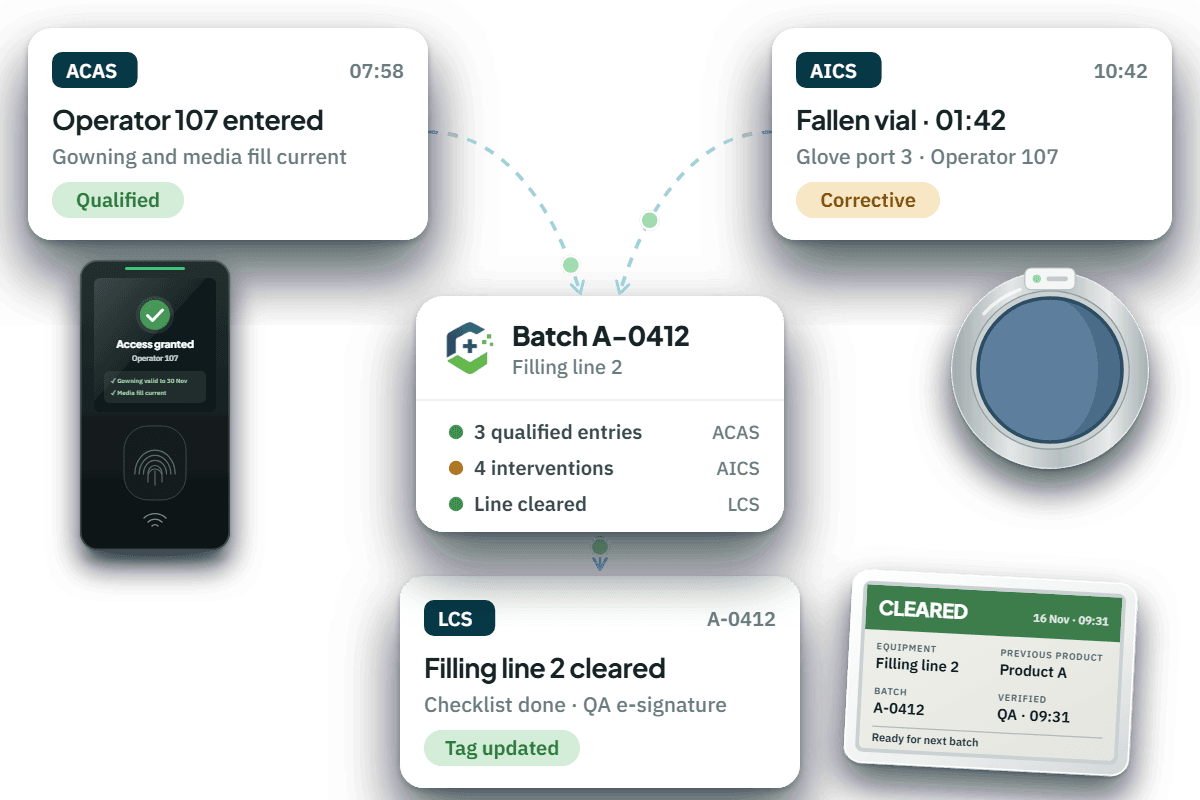
Overview
What is AsepticOne?
AsepticOne is GAMP Lifetech’s platform for digitalised aseptic operations. It controls who may enter the sterile core, documents every intervention made inside it, and runs the line clearance between batches.
Entry authorisation and intervention records sit in one traceable system, so a deviation investigation starts from recorded facts rather than recollection.
Built for: Aseptic manufacturing, production, sterile QA and microbiology teams.
Module stack
3 modulesWhy it exists
What this replaces
Inside the sterile core, the record of what happened is usually written after it happened — by someone remembering.
Run on paper
Run on AsepticOne
What’s inside
The modules, and what each one does
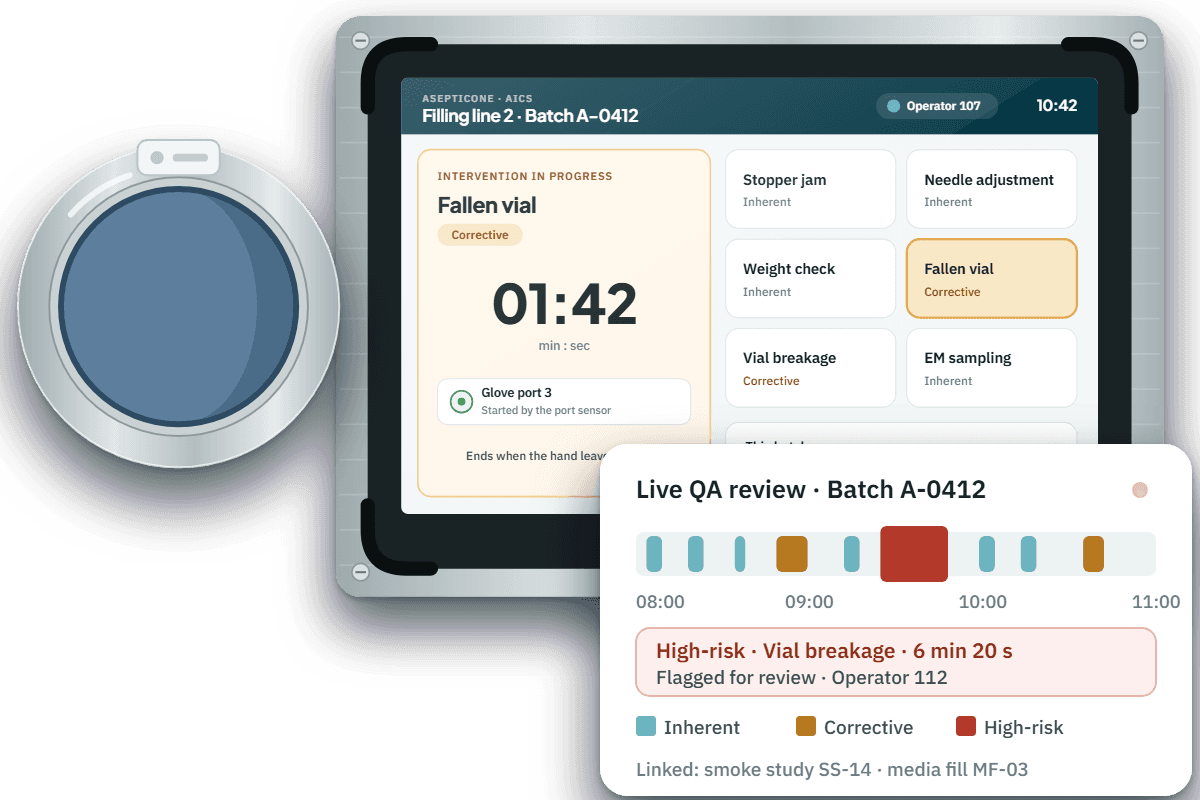
Aseptic Intervention Compliance System
Automated recording of every intervention — type, duration, frequency, personnel, and location — via a dedicated cleanroom interface.
CapabilitiesAICS · Capabilities
- Automated intervention recording on Cleanroom TAB
- Real-time visualisation for immediate QA review
- Linked to smoke studies, airflow patterns, and media fills
- Standardised protocols from historical batch data
- High-risk intervention and abnormal pattern alerts
- Complete traceability for deviation investigations
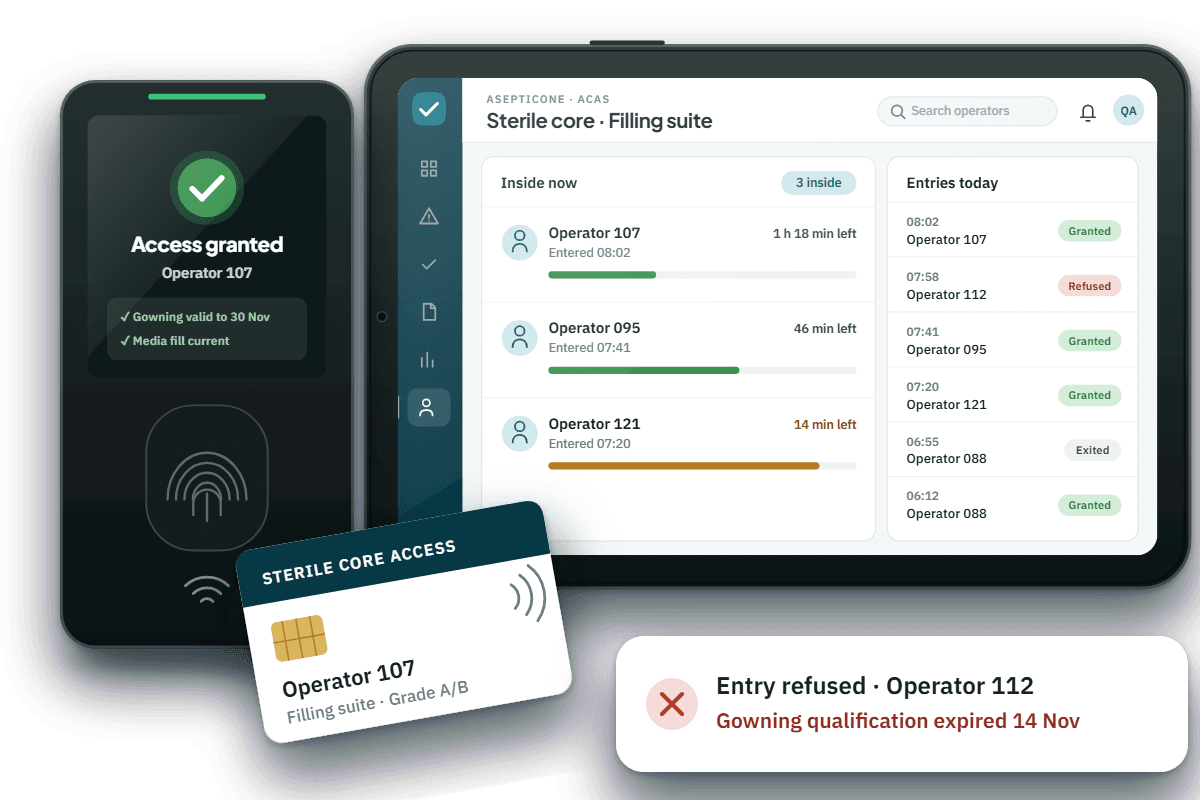
Aseptic Controlled Authorization System
Restricts sterile-zone entry to trained and qualified personnel, recording every entry and exit automatically.
CapabilitiesACAS · Capabilities
- Qualification-gated personnel entry
- Automatic entry and exit records
- Integration with AICS intervention records
- Operator discipline through transparent monitoring
- Liability protection with full traceability
- Cloud, on-premises, or hybrid deployment
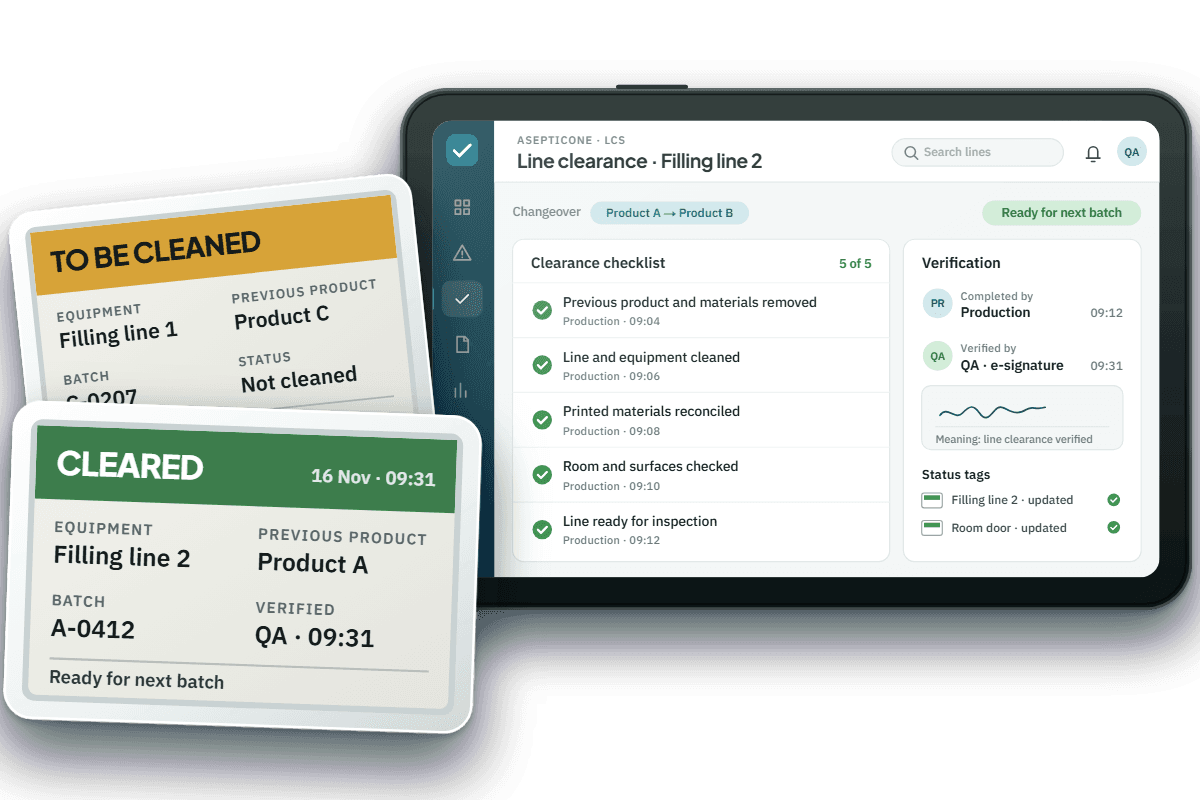
Line Clearance System
Line clearance completed and verified in the system, with colour e-paper tags on rooms and equipment showing their current status in place of handwritten labels.
CapabilitiesLCS · Capabilities
- Line clearance checklists for each line, room and changeover
- Completed by production, verified by QA with e-signature
- Colour e-paper status tags on rooms and equipment
- Tags updated from the system the moment a status changes
- Previous product, batch and cleaning status shown on each tag
- A complete clearance history for every line and batch
Shared across the suite
System Administrator
One set of users for AICS, ACAS and LCS
Operators, supervisors and QA reviewers in the sterile core are created once, whichever of the three modules they use.
- AICS, ACAS and LCS access granted per user, for each plant they work in
- Each person’s role in each module assigned in one place
- Joiners and leavers handled once, not in three separate modules
- Every administrative change recorded in the activity log
Standards
Built against the frameworks you are held to
- 21 CFR Part 11
- EU Annex 11
- EU Annex 1
- GAMP 5
- ALCOA++
- WHO GDP
- GMP
- ISO/IEC 17025
Deployment
Sterile-core records, where your policy requires them
Cloud
Hosted, patched and monitored by GAMP. Nothing for your IT team to run.
On-premises
Inside your own data centre, so entry, intervention and clearance records never leave infrastructure you control.
Hybrid
Application and data split to match your residency policy.
Benefits
What AsepticOne gives you
Recorded, not remembered
Interventions are captured at the point of action, so the record is contemporaneous rather than reconstructed.
Only qualified people inside
Entry is gated on current qualification, and every entry and exit is recorded without anyone having to sign a sheet.
Scientifically justified
Intervention data sits alongside smoke studies, airflow patterns and media fill results, so a practice can be defended rather than merely described.
Traceable when it matters
A deviation investigation starts with a complete picture of who was in the zone, when, and what they did.
FAQs
Questions teams ask before they start
How does AsepticOne support EU GMP Annex 1?
Annex 1 expects an approved list of interventions, a record of every intervention, justification through media fills, and access to Grade A and B areas limited to qualified people. AICS covers the intervention requirements and ACAS covers access.
Is it compliant with 21 CFR Part 11 and EU Annex 11?
It provides the technical controls both regulations require: unique logins, a secure computer-generated audit trail on every action, e-signatures that record who signed, when and what the signature means, and role-based access on every record. Compliance also depends on how the system is validated and used at your site.
Which regulations and standards is it built against?
EU Annex 11 and 21 CFR Part 11 for electronic records and signatures; GMP, including EU GMP Annex 1 for sterile manufacture; WHO GDP for storage and distribution; GAMP 5 for the validation approach; ALCOA++ for data integrity; and ISO/IEC 17025 for calibration.
Can QA review interventions before batch release?
Yes. Interventions are visible in real time, so QA can review them while the batch is still running and have them ready by the time the batch record reaches release.
Does it work with our existing cleanroom doors?
ACAS is designed to control entry to the sterile zone. Tell us about your door and reader hardware and we will confirm how it connects.
Can we see it against our own process?
Yes. Bring the workflow you run today and we will walk the modules through it, rather than through a scripted demo, and be straight about what would need to change on both sides.
Does it extend to modules added later?
Yes. The administration layer extends automatically to every module added to the suite.
Where can it be deployed?
In the cloud, on-premises or as a hybrid. In the cloud, GAMP hosts, patches and monitors it. On-premises, it runs inside your own data centre. A hybrid splits application and data to match your residency policy.
Who manages users and access?
Your IT team does, through System Administrator: users, plants, departments and designations, module access per user, the role a user holds in each module, and password policy, all set once for the whole suite.